Autonomo Vehicle Configurator
I had the pleasure of working on a proof of concept project for US startup company “Hackrod” specialising in generative design and new forms of manufacturing to fundamentally disrupt the vehicle configuration process. I worked on the very first iteration of the “Autonomo” platform, built using the Unreal Engine. The platform had both desktop and VR interaction models that would allow a user to select and configure a custom vehicle, in the prototype this was a motorcycle, and was built to utilise a database back-end that could be updated by vendors through a set of custom tools.
I worked on the initial database setup and vehicle configuration, the desktop interface, the VR interaction model, look development, RnD, as well as providing art support to a small team of artists. All feature development in Unreal was handled via blueprints. I worked alongside one other programmer who was looking into constructing procedural geometry based on CAD data that would be used for the vehicle components to allow the user to deform and shape surfaces.
The following series of images show some of the Blueprint based logic and framework for interaction, as well as the database driven back-end where all the component data for the individual parts was stored. You can also see some of the branching that allowed the same framework to be used for the full VR interaction model, as well as the simplified mouse based desktop interaction used for the Arc bike demo.
Here you can see 2 examples of completed assemblies, with their respective component databases and categories highlighting how flexible the system could be.
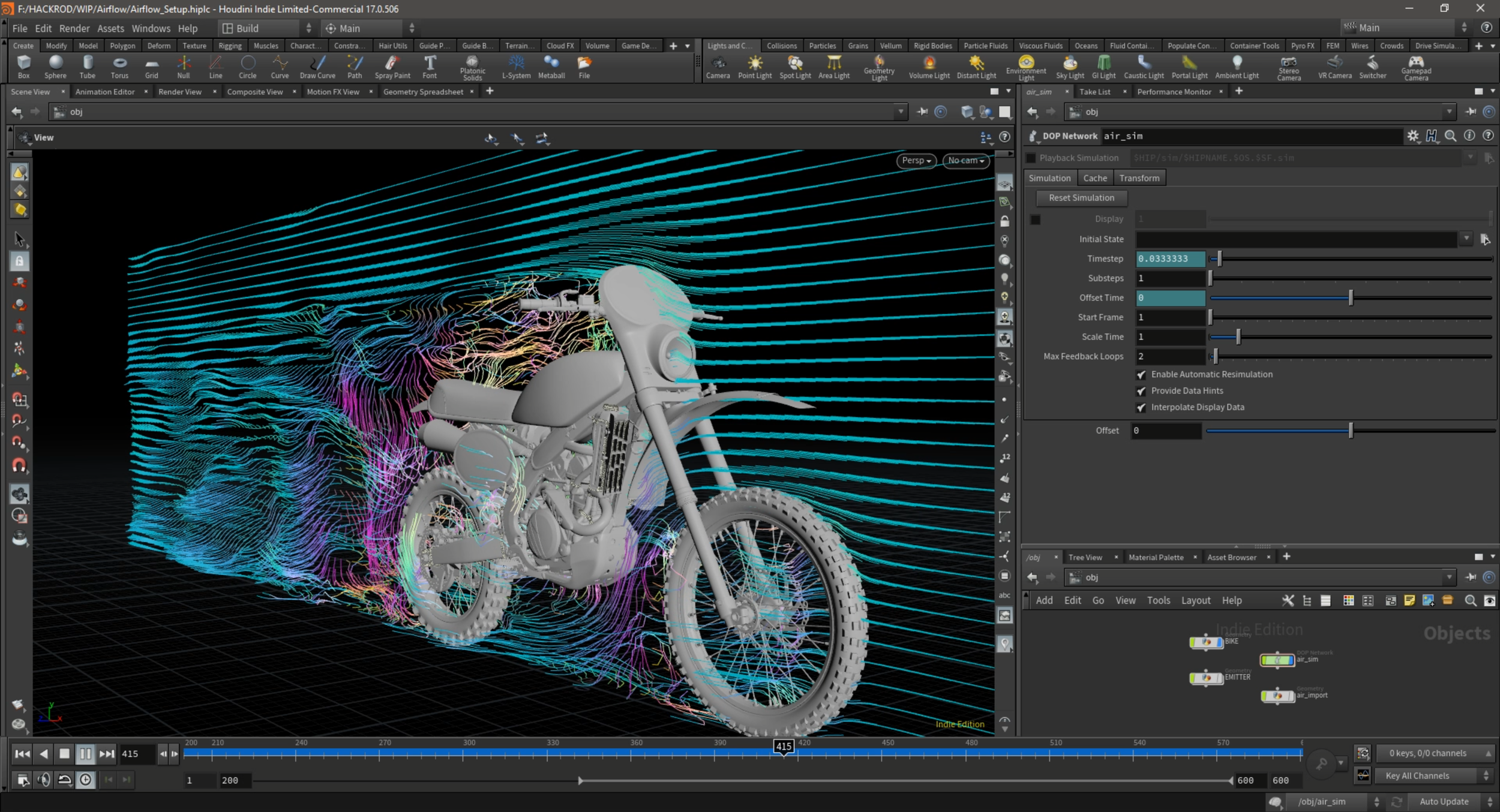
One of the target features of the configurator was the capacity to analyse any vehicle configuration at will and to visualise things like air-flow. In order to communicate this in the prototype, I built a number of vector fields for each of the primary motorcycle bodies that I used to advect particle motion in engine. Initially authored using PhoenixFD in 3D Studio Max and exported using a custom script to generate vector data in a format that Unreal could use, I later switched to using Houdini and its Pyro solver for greater precision and control.
The following video shows the vector field working in VR. In this case the bike is a client asset used for a VR demo that was showcased at the Goodwood Festival of Speed. The bike is the “Arc Vector” electric bike. You can see the vector field being used to advect particle streams that the user could interact with to visualise air flow around the vehicle.
We also built a modified prototype based on the same underlying tech, although in this case non-VR based, and exposing configuration choices as materials and paints
The following images show aspects of the custom Pyro solve I did in Houdini as a proof of concept for the MX Bike, that would be later exported as a vector field into Unreal and used to drive particle motion in the “Aero” mode of the configurator. I'd eventually end up generating multiple instances of this data for each main vehicle category as best-fit simulations to give a reasonable idea of air flow, or at least good enough as a proof of concept for the platform.